Security · June 1, 2026
There is a version of the cybersecurity story that gets repeated in every LinkedIn post, every bootcamp ad, and every “top careers of the decade” listicle. The field is exploding, there’s a permanent talent shortage, and if you just collect a few certs you’ll walk into a great job. Most of that is actually true. The shortage is real, the growth is real, the pay is real. What the story leaves out is that the shape of the entry point is changing, and if you walk in expecting the old map, you can waste a couple of years before you notice.
This isn’t a “don’t bother” post. It’s the opposite. Cybersecurity is one of the best careers you can pick in India right now, and I’d encourage almost anyone curious about it to start. But I want to give you the honest version of how to enter, because the honest version is the one that actually gets you in.
The growth first, because it’s genuinely exciting. India is staring at a demand for roughly one million cybersecurity professionals while only about 80,000 qualified experts exist today, a gap NASSCOM and DSCI put at around 120,000 unfilled roles entering 2026. Bengaluru alone had over 25,000 active cybersecurity postings as of April 2026, with hiring up 22% year on year. The DPDP Act coming into force, plus RBI, SEBI, and CERT-In mandates, means every serious company now needs people who understand how to defend data. Salaries run from about INR 4 to 8 lakh for freshers (roughly $4,800 to $9,600) up to INR 60 lakh and beyond for senior leadership (about $72,000+). None of that is hype.
But “the field is growing” and “the entry tier looks like it used to” are two different claims, and they’re quietly drifting apart.
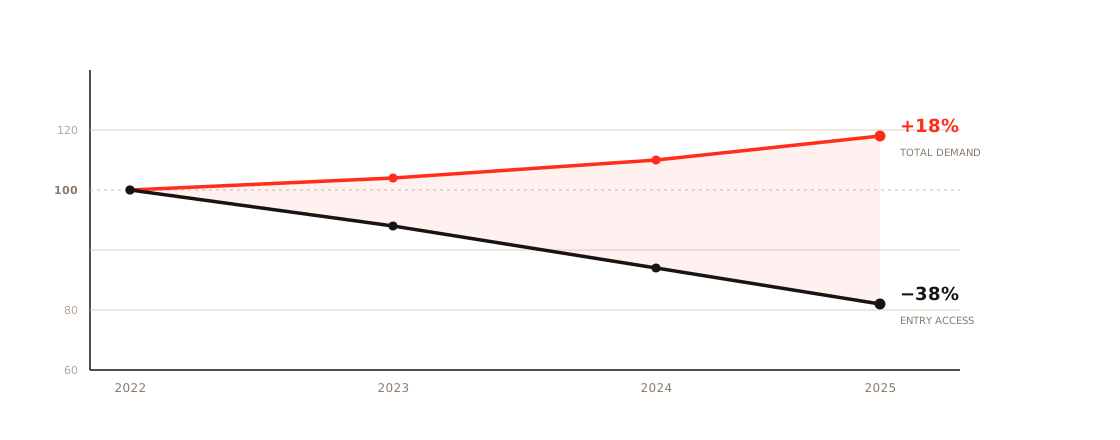
Growth at the top, change at the bottom
Here’s the part the listicles skip. The growth isn’t spread evenly across seniority. It’s concentrated at the experienced end, and the entry end is being reshaped rather than simply expanded.
The 2026 hiring data makes this fairly clear. Globally, roughly 70% of organizations say they’re prioritizing senior-level talent, while only about 12% list junior or entry-level hiring as a primary focus. Some companies made very few entry-level hires while still naming “talent shortage” as their top challenge. That sounds like a contradiction, and partly it is. But it’s worth understanding why it’s happening, because the popular explanation has the mechanism backwards.
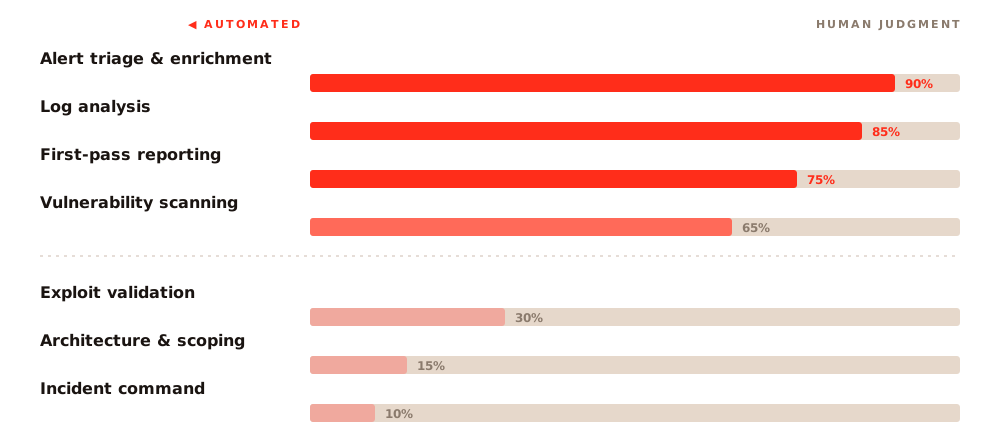
The popular version says AI will replace senior experts first, the people doing the “complicated” work, while juniors who “just know the tools” stay safe. The reality runs the other way. AI is very good at exactly the tasks that used to fill a junior’s day: triaging alerts, parsing logs, running scans, drafting first-pass reports, correlating events. In Indian SOCs, AI now handles something like 40% of Level 1 triage. A capable SIEM with good detection content and a half-configured SOAR pipeline already does work that used to occupy a row of tier-one analysts.
What AI is not good at is the judgment that sits on top of that output. Deciding what’s actually exploitable versus noise. Understanding how a finding maps to a specific business and its architecture. Scoping an engagement. Knowing which alert is a nuisance and which is the opening move of an intrusion. Translating any of it into something leadership can act on. That work doesn’t get automated. It gets more valuable, because the cheap layer underneath it just got cheaper.
So the senior professional isn’t endangered by AI. They’re amplified by it. And the junior role isn’t disappearing either; it’s shifting. The day used to be “click through alerts.” Increasingly it’s “direct the tools that click through alerts, and catch what they get wrong.” That’s a different job, and the people who learn it early have an enormous head start.
The pipeline question worth taking seriously
There’s a real structural tension here, and it’s worth naming plainly rather than pretending it away.
Expertise in security isn’t something you can install. You earn it by doing the unglamorous work: staring at logs until the patterns become obvious, validating findings until you can smell a false positive, sitting through incidents until your instincts calibrate. Those entry-level reps were never just jobs. They were the apprenticeship, the mechanism by which the industry produced its next generation of seniors.
If AI absorbs the simplest version of that work, the industry has to find new ways to grow people, because the experienced pool everyone is bidding for is finite and it ages out. Every security architect and incident lead was once a beginner who got the chance to be mediocre on someone’s payroll while they learned. The field still needs that pipeline; it just needs a new shape for it. The good news for anyone starting now is that this makes early-career people who can work alongside AI unusually valuable, not unusually disposable. The demand is there. The trick is meeting it with the right skills rather than the old ones.
The barrier-to-entry myth, and how to use it to your advantage
There’s a comfortable half-truth floating around: that the barrier to entry in cybersecurity is low. It’s worth separating two things that get conflated, because understanding the difference is genuinely useful to you.
The barrier to learning security is low and getting lower, and that’s wonderful. There are free labs, affordable courses, open courseware, and more quality material online than any university offered a decade ago. Anyone with curiosity and a laptop can build real skills. That part of the dream is true.
The barrier to getting hired is higher, and rising. The reason you constantly hear “anyone can break into cyber” is that a whole industry’s revenue depends on you believing the learning and the hiring are the same step. Bootcamps quoting high placement rates, cert mills, and roadmap-selling influencers profit from the learning side while leaving you to figure out the hiring side alone. They sell the on-ramp without mentioning that the on-ramp now asks for more than a certificate.
In India specifically, you can see this in the numbers. A degree alone might start a fresher around INR 4 to 5 lakh (roughly $4,800 to $6,000), while a fresher with a recognized cert and real hands-on skill starts closer to INR 6 to 8 lakh (about $7,200 to $9,600), and freshers with a genuine internship or a respected practical cert like OSCP increasingly start at the top of that band. The lesson isn’t “certs are a scam.” It’s that certs are table stakes, and what actually moves you is demonstrated, hands-on judgment. That’s good news, because judgment is exactly the thing you can build deliberately.
So this is not a reason to stay out. It’s a reason to enter with your eyes open and aim at the right target.
What actually compounds: build toward the deepest AI moat
If the repetitive layer is being automated and the judgment layer is being amplified, then the whole game, for newcomers and veterans alike, is to build toward work with a deep AI moat. By which I mean the work that AI makes you better at, rather than the work AI does instead of you.
There are two strategies, and they stack.
The first, and the one I’d point most newcomers toward, is to get genuinely good at wielding AI in security. You don’t need to be a data scientist or train models. You need to be fluent enough to know how the tools think, where they’re blind, how to direct them, and how to check their work. The beginner who learns to orchestrate AI across a detection pipeline and catch its mistakes is worth far more than one who tries to out-click it. This moat is the most accessible one, you can start building it on day one, and it sits on top of everything else you learn.
The second is to grow toward a niche that’s structurally hard to automate, where the value comes from judgment, context, adversarial creativity, or accountability nobody will hand to a model. Exploit validation and development. Security architecture, where the right call depends on understanding a specific business and its risk appetite. Incident command, where someone has to make decisions under uncertainty and own them. Offensive work that depends on thinking like a human attacker. GRC and regulatory translation, which the DPDP Act has made a boardroom priority in India and where the hard part is human and organizational. The OT and ICS world, where physical consequences and brittle legacy systems keep the judgment stubbornly human. You don’t need to start here. You grow into it, and AI fluency gets you there faster.
The common thread is simple. AI compresses repetition and rewards judgment. The durable career isn’t the one furthest from AI; it’s the one where AI is your force multiplier. The depth of your moat is just how hard it is to turn your work into a prompt.
So where does that leave you
If you’re trying to get in: this is a great field and a great time, and you should go for it. Just don’t enter on the old map. Learn to direct AI from the start, treat certs as a foundation rather than a finish line, and put your energy into building a portfolio that shows judgment. One real project you can talk through beats a wall of certificates every time. The demand is enormous and it is not going away.
If you’re already in: the encouraging part is that AI is amplifying you, not replacing you. The work is to keep growing the people coming up behind you, because the field’s future depends on the next generation getting the same chance to learn that you did, even as the shape of that learning changes.
The shortage everyone talks about is real. The opportunity underneath it is bigger. The only thing that’s changed is what you need to bring.
Security · June 1, 2026
The Shrinking On-Ramp

INDEX
ALL
SEC
RES
FIN
WRI
NOT